Week 6: Human resources: Empowering informality and the transformation of the development subject
DVST 6901: The global politics of development (Semester 2,
2026)
September 7, 2026
A major shift in development politics occurs in the context in a transformation of state power in response to a crisis in capitalism.
Main reading: Elyachar (2005), intro. and chaps. 3-5
On the waterfront
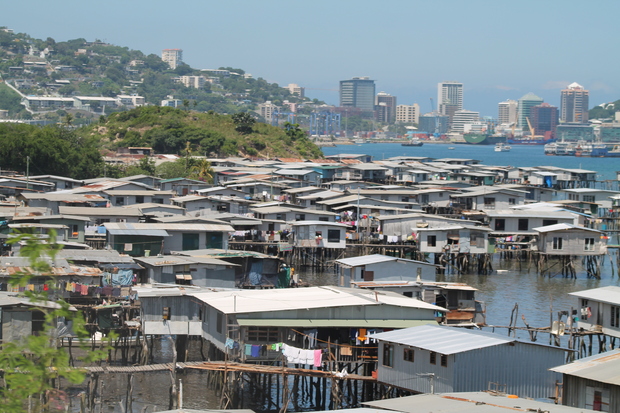
Pooling knowledge
Use this Padlet to comment: https://padlet.com/sydney/where-can-we-find-similar-scenes-what-do-you-see-in-the-pict-s023cfx27cnyj1oqi44o
- What do you see? What do you infer about the scene?
- Where else can you find this kind of place?
- Have you ever been to or lived in a place you think is similar?
- Is this place an indicator of “development”? What does it indicate? (And what kind of development?)
Two stories
The postwar boom was a blip
Mass production for mass consumption led to mass affluence, a robust middle class (based on a breadwinner model), and a new social contract in the capitalist West.
The boom entrenches an unequal capitalist world system of core and periphery economies and the “development of underdevelopment” (Frank 1966).
Crises of profit and external shocks lead to political pressure on states for “free trade,” leading to flexible production, offshoring and outsourcing, and deindustrialization of affluent economies, as well as a narrower social contract.
The postwar liberal order shifted after the Cold War
State-led development strategies have always had mixed and modest results.
Welfarist visions of development-as-self-sufficiency have been hamstrung by global finance by wealthy capitalist states.
International financial institutions push developing states to change their economies to be more compatible with a peripheral niche, and with adaptation to post-Fordist “globalized” production. Structural adjustment polices become common conditions for development loans.
- Developing states are expected to mirror the new social contract (“neoliberal”) in wealthy states.
Under imposed policies that reduce state spending, state-led development interventions are less feasible and have little support. “Civil society” is expected to take over.
- Alternative approaches to development have always been pursued at local levels through community organizations and churches. This participatory “small is beautiful” ethos is reinvigorated by the shift to the “nongovernmental” or “third” sector as the motor for improving material and social conditions.
Another look at power and the state
First, states are weird. People have lived without states for most of their history.
Second, how we conceive of states needs to keep up with the diverse forms they take. We need to revisit an earlier discussion.
We have considered several ways to think about power. Each has implications for what we think a state is.
Power is force. (A gets B to do what B doesn’t want to do, because in an ultimate sense, A can coerce B to do it.) State power is the exclusive right to use legitimate force.
- This is Weber’s model and what Foucault calls sovereign power—the power a king has over subjects to tell them what to do and what not to do.
Power is a relationship or power is a inherent in the situation. (A has power over B because A stands in a particular relation to B. A observes B; A and B have definite roles in a larger order.)
- This is why Foucault turns to the Panopticon. A system can function without an actual head, and without even an actual recourse to coercion. Everyone acts as if there is a sovereign king but there is none and one isn’t needed.
We touched on another Foucauldian argument about power, which is what he says comes after sovereign power.
For Foucault, there is a historical shift whereby the principal object of government is management of material conditions, i.e. the economy. He argues that political theory is still stuck in the past in which kings ruled as sovereigns, and talks about power as coercion. What political institutions really do in the modern age is cultivate the conditions for growth.
This is the governmentalization of the state. It is marked by the responsibilization of the subject. The state achieves its aims specifically by defining what is the individual’s responsibility.
As Weber might say, we live in an iron cage, a prison without walls, but not because we internalize the surveilling eye of the warden. We respond to incentives we believe are in our self-interest but which function to make ourselves countable units in a measure of the population’s health.
The so-called informal economy
What is an informal economy?
Throughout the world, there are communities who (1) have little to no means or opportunity to participate in market enterprise, but (2) do not benefit from a fully-developed system of total services in which they can depend on reciprocal ties.
People draw on their reciprocal ties to others to generate capital they can exploit to engage in commodity trade and profit earning, and vice versa.
- Making gin in Frafra “slums” around Accra, Ghana (Hart 1973)
- Selling betel nut around PNG (Sharp 2013, 2016)
- Selling tobacco in Auhelawa
Elyachar’s question: Why economy?
Masters pass on knowledge to the next generation of craftsmen. Why do we assume they are businesses and not schools?
This is a neglected dimension of “globalization”—Capitalism expands, and in parallel the logic of capital moves into new domains, including domains of reproduction.
Informal economies: Invisible no more
Informal economies were the buried story of the so-called developing world for most of the 20th century. Now everyone wants to recognize it.
- Nigeria estimates that over half of the nation’s economic activity is informal (Ekugbe 2024). They decided to count it as part of their GDP (Sakr 2025).1
A master and a gentleman
Look at page 138 of Elyachar’s book:
While Samir was gada‘, he did not relate to all masters bil-gada‘ana. He regularly shared customers with a number of body shops, but used different systems of exchange, some with commission and some without: “There are two or three body shops I deal with regularly. There are those I deal with for a commission and those I deal with without money.” When differences in social status and cultural practice precluded close relations bil-gada‘ana, Samir’s courtesy toward his neighbor drew on, and reproduced, the value of neighborly relations. This was true of his interactions with a machinist who worked nearby. “I do business with — — —— — — without money [bil-gada‘ana]. Me and him, it’s neighbors, not biznis . That’s a colonel and an engineer. We give and take, there’s general goodwill. But I feel the social di√erence between us. We send back and forth customers without money. He’s sent me five cars to work on, cars of his brothers, his sister, relatives, and people he knows and sends to me to take care of.” (Elyachar 2005, 138)
- Elyachar notes that Samir uses a more general and ambiguous term which she translates as “do business” but can also refer to “conduct yourself in relation to another” (similar to the English idiom deal with, or having dealings with.)
It’s who you know
On page 140, she writes:
State officials are a common sight in the workshops of el-Hirafiyeen. Masters are happy to enter into exchange relations with state functionaries. They have much to gain from such relations. A general principle prevails in workshops that gaining a customer is more important than short-term economic profit. This principle takes on additional importance when the customer is connected to the state. There are many benefits in apparently unprofitable business relations with low-level functionaries who assess taxes and fines, and who work in the offices of local government where many decisions affecting masters’ lives are taken. The master is happy to do a favor for such a customer. The master never knows when he will need to call on an official for a favor in return— perhaps to reduce a tax bill, or to settle a fine incurred for employing child labor or using dangerous chemicals in the workshop. (Elyachar 2005, 140)
Notes
Keywords
neoliberalism, markets, social capital, informal economy and informality
Learning outcomes
- Understand shifts in development practice as functions of new approaches to social policy and responses to shifts in the global economy
- Be able to critically evaluate ideas of entrepreneurship, empowerment, and inclusion
References

As some of these news reports suggest, yes, a lot of informal economic activity is technically illegal. When people are excluded from so-called formal, mainstream institutions like banking, property ownership, tax collection, water and sewer systems, electricity, access to courts, police protection, and lack a responsive government, it’s not surprising that they operate on the margins of the law. I mean, where else is left to operate? Protection under the law by state agencies is one of the many things people don’t have; reciprocal ties compensate for this.↩︎