An “arm ornament”

ANTH 1002: Anthropology for a better world (Semester 2, 2026)
September 1, 2026
When people cooperate, they often exchange, but they are not negotiating a deal for themselves. More often exchanges are gifts and come with rules. Capitalism and a consumer society threatens something basic and fundamental to social life itself.
Main reading: West (2012)
Other reading: Eriksen (2015); Lyon (2020); Marx ([1867] 1972); Mauss ([1925a] 1990)
Slides available at https://anthrograph.rschram.org/1002/2026/05
To adopt a position of cultural relativism, you need to assume the same thing can be seen two different ways, like a duck-rabbit optical illusion.
But this is just the first, basic step.
To be able to understand the Tuvalu climate visa or the Vanuatu case for climate harm, for instance, you have to make a bigger switch in your perspective from duck to rabbit:
to
And, more generally, we need to switch from an egocentric perspective
and switch to a sociocentric perspective
Learning to see the social, collective dimension of existence instead of individuals is anthropology’s way of challenging very influential ideas about how the contemporary world works, and what it can be.

Emile Durkheim is a founding figure of sociology and anthropology
Marcel Mauss was a nephew and student of Durkheim
Mauss grew up in a world in which everyone assumed that people acted as self-interested rational maximizers
For Adam Smith, for instance, says
And yet, most people in most places don’t do this. Exchanges take the form of presents. Often people exchange identical things.
Mauss says: Because you have to.
Gifts come with obligations because a gift is part of the system of total services. Specifically, giving a gift involves a triple obligation:
Society, in essence, is a total system. Reciprocity is an expression of this fundamental reality of society. We may not even be aware of this state of interdependence, but it is still there.
For Mauss, the Maori word hau means the “spirit of the thing given” (Mauss [1925b] 1990, 10).
When someone gives a gift, they give part of themselves.
“The hau wishes to return to its birthplace” (Mauss [1925b] 1990, 12).
What, then, is society?
Mauss says that the essence of society is a “system of total services” (Mauss [1925b] 1990, 5–6)
In a system of total services,
It is a state of total interdependence.
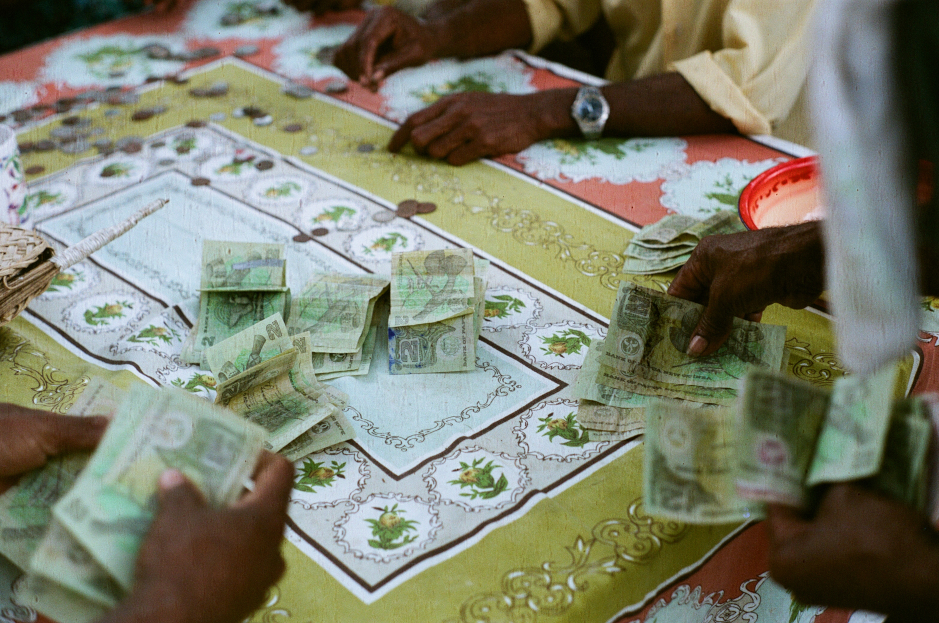
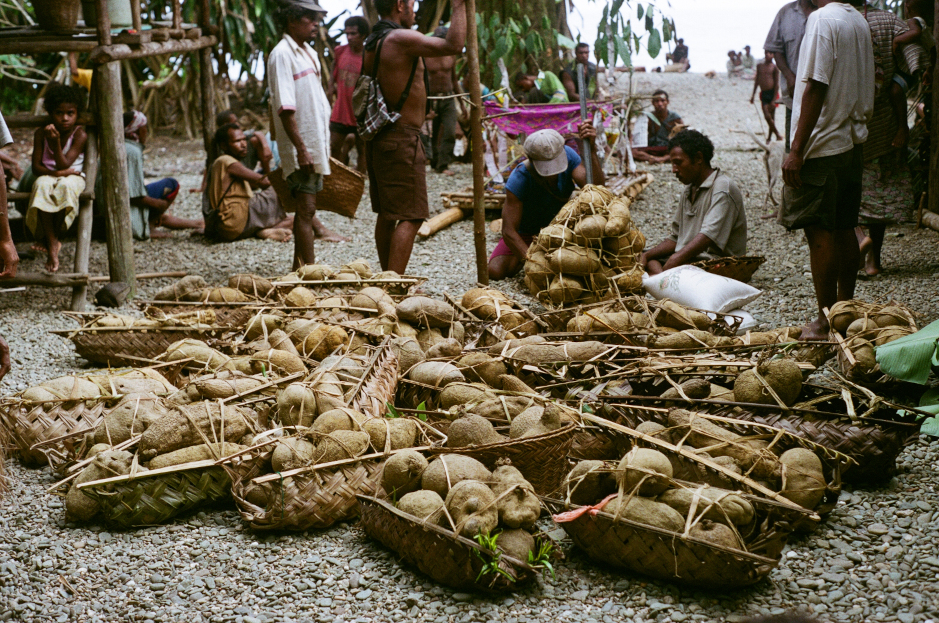
Every family in Auhelawa produces most of their own food grown on their own lands, and the most important of these are
Yet although most of people’s effort and thinking goes into growing these yams, most of the ʻwateya are not grown as food for one’s family.
Garden produce for one’s own daily needs is not subject to a norm of generalized reciprocity. People are humiliated if they have to ask for hagu or velau of food for their own meals.
Obeying a norm of reciprocity does not mean that people are all willing to share and care for each other. The norms of different kinds of reciprocity create a precise structure that governs relationships.
What if everything you owned “wished to return to its birthplace” (Mauss [1925b] 1990, 12)?
Everything of value would be embedded in social relationships.
In many societies the embeddedness of value takes the form of a system that organizes objects into distinct, ranked spheres of exchange. One example is the Tiv of Nigeria, who have three spheres:
Some things, like land, cannot be exchanged for anything, but are inherited (Bohannan 1955).
Bohannan claimed that money would disrupt the separation of spheres of exchange. However…
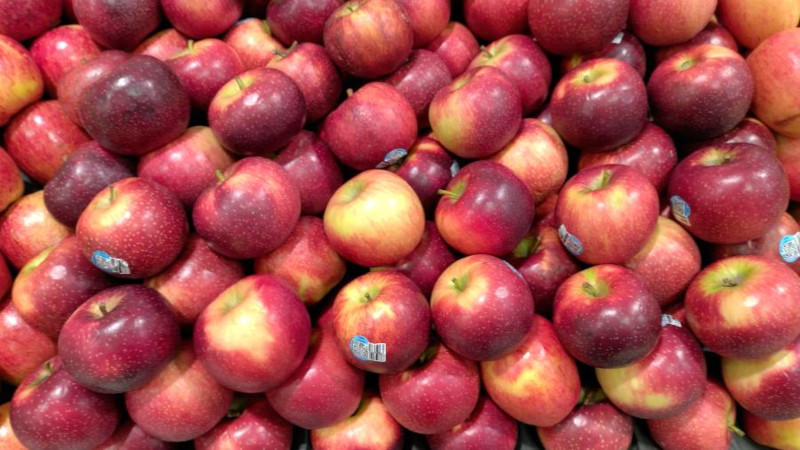
Go to this Mentimeter poll: https://www.menti.com/alp1jpwhtwx7 (or go to https://menti.com and use
code 1508 9305).
Select which one of the objects we’ve seen so far has the most in common with apples
Think of the value-relationship that normally defines these things.
Talk with each other. Why did you choose what you chose?
For capitalism to emerge, first the concept that one’s property can be owned privately has to be instituted.
A worker under capitalism brings “his own hide to market and has nothing to expect but – a hiding” (Marx [1867] 1972, 343).
What do you think he means by this? Buzz about this. What do you associate with the word Capitalism? Marxism? When did you first hear these words? Have you ever read the Communist Manifesto?
This might sound like a simple dichotomy:
societies based on gifts, reciprocity, and a system of total services;
capitalist societies based on commodity production and consumption.
Instead, consider this possibility:
Every society is based on a system of total services, even if its members don’t know it and cannot see it.
Some societies impose a specific set of social fictions:
We see both the reality of society and the fiction of individual alienation in every society, and they interact in several different ways.
Bourgeois culture teaches us that we are each individual economic actors and that there is no society on which we depend.
But societies are real. We really are all part of a system of total services.
Yet, also, every society is based on a fiction.
We need to be part of a social order
But any one social order will involve lying to ourselves. * And some social fictions completely obscure the existence of any social ties.
No person is an island. Everyone who has ever lived was also a member of a larger community from the day they were born. By acquiring the cultural patterns of one’s community, one is also recruited to play a part in that community as a system. To understand people’s lives, we must see them as components of a total system.
This week, we examine a major theory of societies which argues that societies are total systems. This means that a society is always more than the sum of its parts, and that people in society are tied to each other and the whole social system. This theory is developed by Emile Durkheim. Durkheim’s student, Marcel Mauss, applies this theory to economic behavior. Mauss observes that most exchanges are not trade or barter, let alone buying and selling, but gifts. He asks why people often feel an obligation to reciprocate, to respond to a gift with another gift. Mauss concludes that the gift and its obligations are a very basic form of social integration.
Mauss’s theory of the gift provides an important conceptual touchstone for comprehending the many different forms of life people have created. While each society is different in lots of ways, every society is an expression of the fact that people are incomplete. They need other people, and those other people need everyone else in the community as well. We feel the force of reciprocity because we are always playing a role in what Mauss calls a system of total services (Mauss [1925a] 1990, 5).
Yet, perhaps more importantly, with the theory of the gift we are also able to understand a fundamental conflict in global history, one that has influenced every society and every person alive today, although in different and unequal ways.
In the contemporary era, the gift is haunted by another, completely different kind of social institution, a market in which people buy and sell commodities, and in which people accumulate capital that they own as private property. This alternative way of organizing societies is actually relatively recent when considered in light of about 100,000 years of human history. Yet, its ideas are powerful and have had a huge influence. Everyone today is in one way or another part of a global capitalist system, and they participate in this one system in many different and unequal ways in the context of their own local communities.
Anthropology has generally taken its concept of the commodity form from Karl Marx. Importantly, for Marx, a system in which people meet their needs through the buying and selling of commodities is not a system that liberates people. Individual freedom and enterprise in the market is a fantasy which the ruling class of the capitalist system promotes. In a capitalist system, everyone is governed by the logic of the commodity, and thus must conform to a specific institutional pattern in order to participate in this system.
This is not only true in affluent, industralized, mass societies. Capitalism and the system of commodity exchange has also reached out to every place on earth. The institutional rules of capitalism, the logic of commodities and commodification, also enter into communities where people have other ways of meeting their own needs and their community’s collective needs. We can understand this world in all its diversity as many different variations on a theme: the encounter between two distinct systems, the gift and the commodity. In this and next week we will explore the complexity of these interactions in depth. What we find is that this encounter leads to many different outcomes. While it is true that the global capitalist system does not destroy local systems of cooperation, gifts and commodities are fundamentally different and each threatens the other when they meet.
Look at this quotation from West’s ethnography of Gimi coffee farmers in Maimafu, a village in the Papua New Guinea Highlands:
The first sweet potato came from the forest, from kore maha (wild land and ancestor land). In one Gimi story a man died and his children buried him. That night one of his daughters (his son’s wife) dreamed of her father’s grave. In the dream a vine was growing from the grave that she had never seen before. When she woke up the next morning she and her co-wives went to investigate and found that there was a unique and unknown plant growing from the center of the grave. They nurtured the vine, and once it was mature they cut bits of it and replanted it all around their village. The first sweet potatoes came from this vine. (West 2012, 119–20)
Recall also that when asked where coffee plants come from, Kobe, one of West’s informants said, “They are from somewhere else, Australia at first, I think” (West 2012, 121).
What can you infer about the difference between coffee and sweet potatoes from these ethnographic facts?
Mauss says that there are three obligations attached to every object given as a gift: To give, to receive, and to reciprocate.
the three obligations of the gift, Marcel Mauss, Emile Durkheim, capitalism and the commodity form, private property